I first came across TOON (Token-Oriented Object Notation) on LinkedIn, where developers were discussing its promise: lossless compression of JSON and YAML, specifically optimized for large language models (LLMs). The core idea? Reduce token count without sacrificing information, which directly translates to lower costs and potentially faster processing.
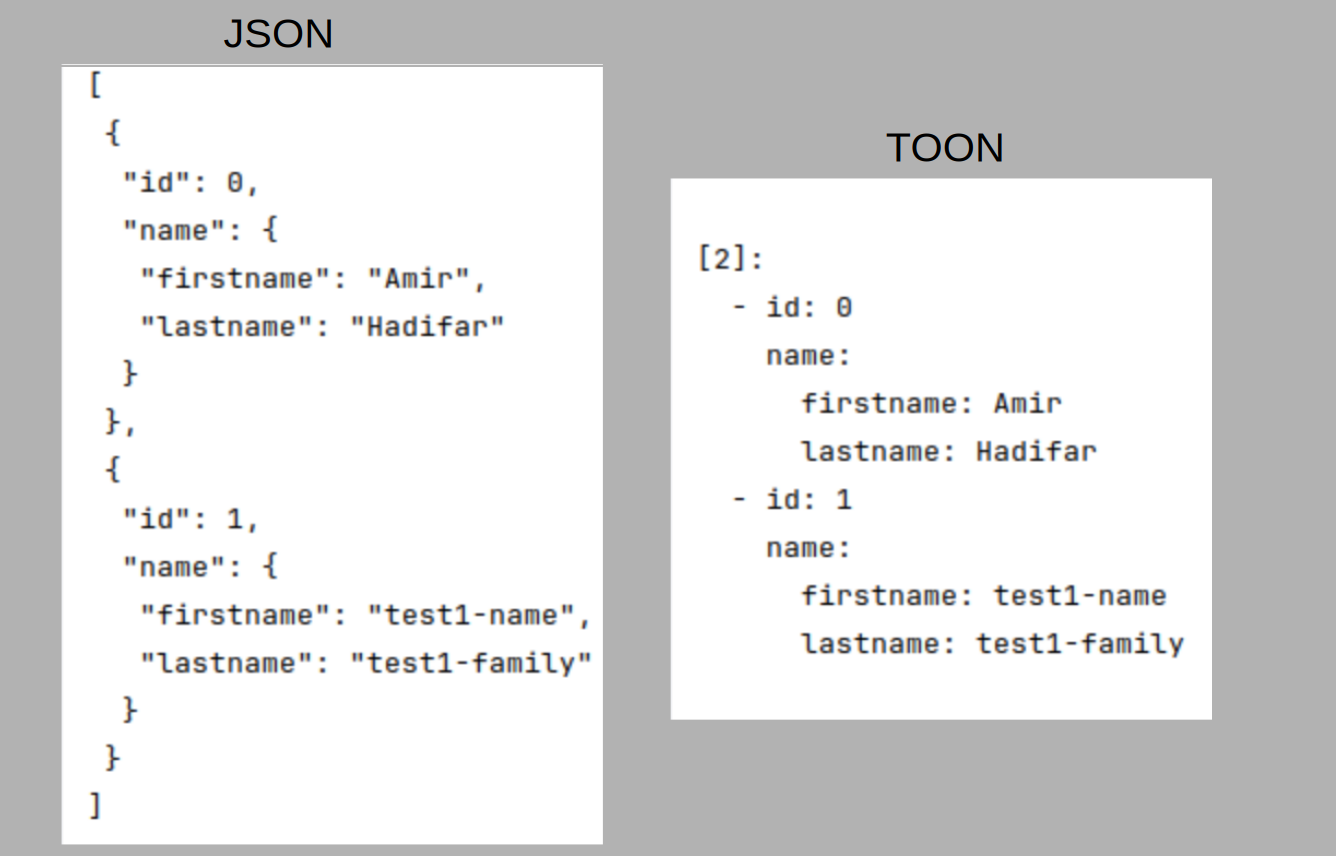 Comparison between TOON and JSON for nested objects
At first glance, TOON looks familiar yet distinct. For instance, a TOON object always begins
with the number of items (e.g., [2] in the figure above), and unlike JSON it drops
quotation marks (") around keys. This minimalism becomes especially powerful with flat
data structures. In those cases, TOON starts to resemble CSV format: a header row followed
by values. The result? Significant token savings (I used their Python version for my
experiments).
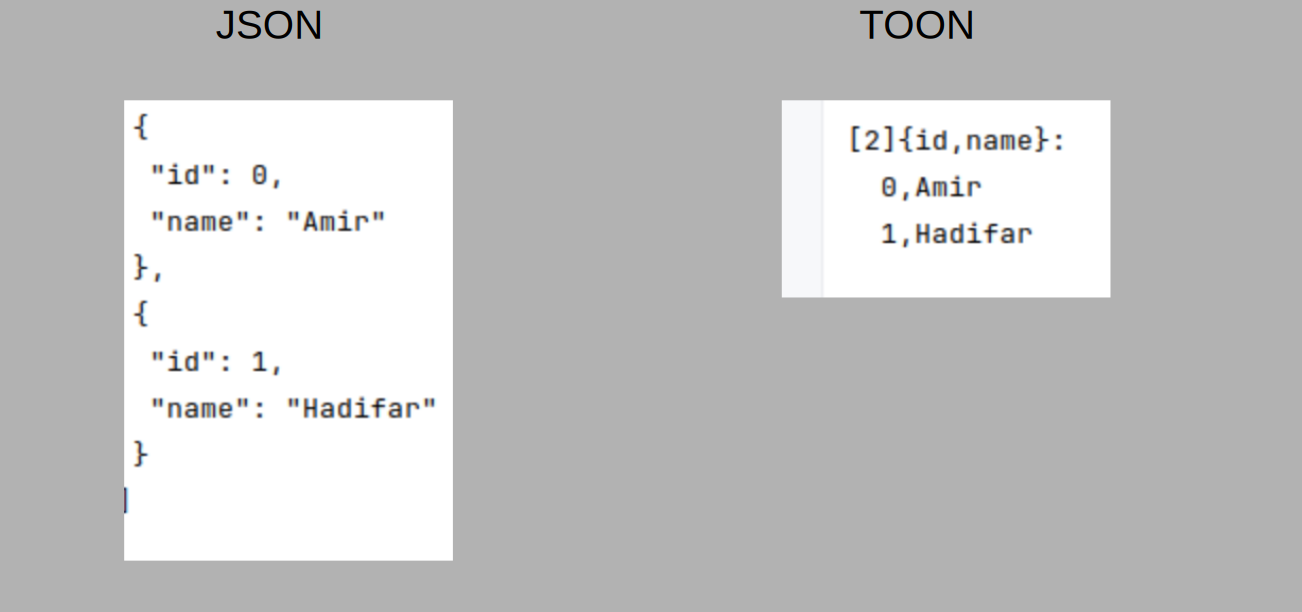 Comparison between JSON and TOON for flat objects
According to the project’s evaluation, which tested 209 questions across several tasks, TOON achieves “higher accuracy while using fewer tokens.”
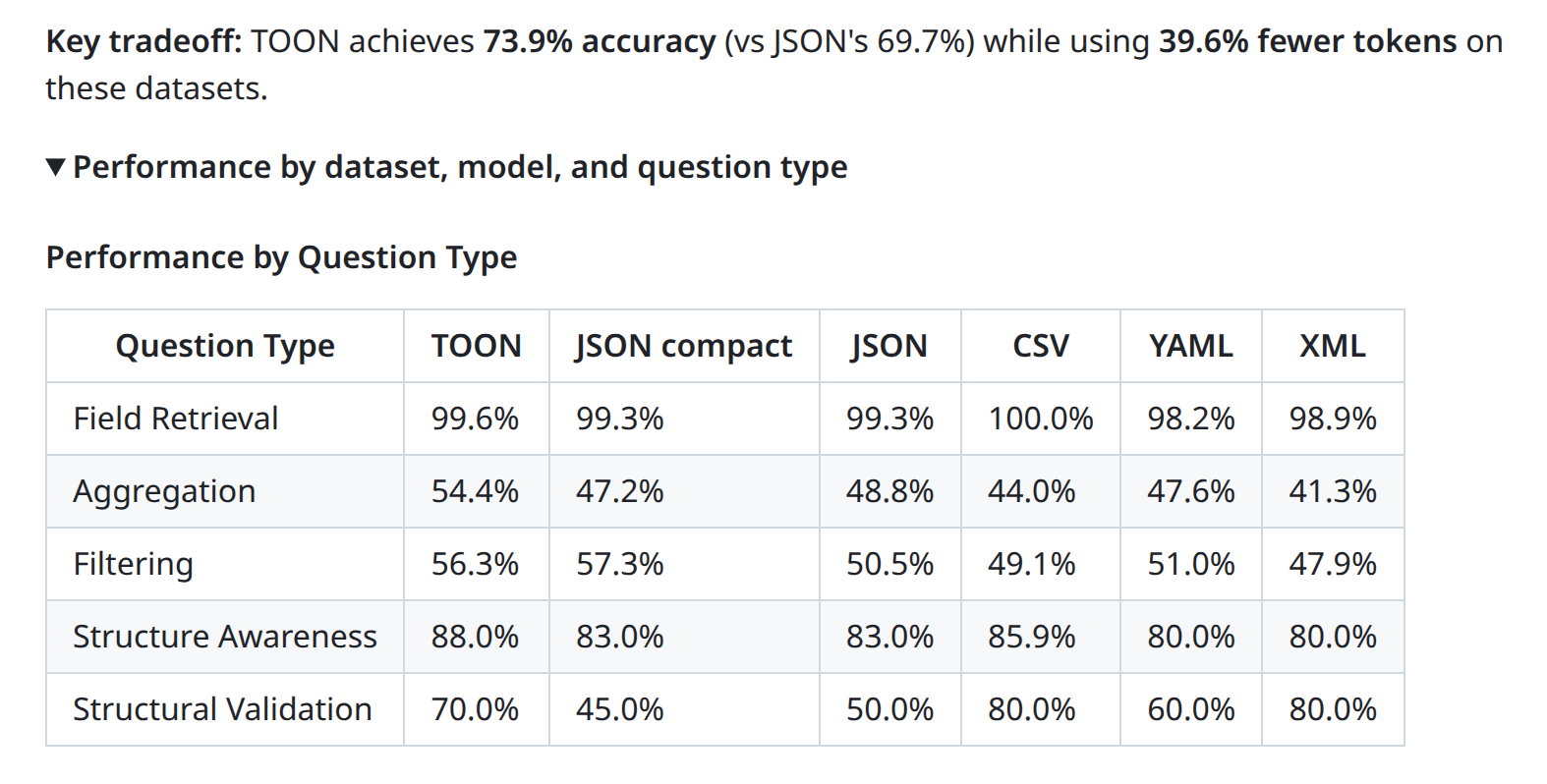 Evaluation of TOON on 209 questions
The question distribution breaks down as follows: Field retrieval (33%), Aggregation (30%), Filtering (23%), Structure awareness (12%), Structural validation (2%). With this distribution you can see why there’s a large gap between JSON and TOON in structural validation — they validated it on 2% of 209 questions (4 or 5 questions).
Digging deeper into their methodology and prompt design, I’m skeptical that the reported accuracy gains are as robust as claimed. The token savings, however, are real, especially for flat data. Here is the prompt used for the evaluation:
| |
That said, there’s a caveat worth considering: LLMs are typically pretrained on standard formats like JSON and YAML, complete with proper spacing, quotes, and structure. Introducing a non-standard notation like TOON might increase the risk of hallucinations.
So while TOON is a clever optimization for specific use cases — especially cost-sensitive, flat-data applications — it’s not a drop-in replacement for traditional serialization formats.